What is the new Canada PR points system?
Published 23 November 2026 by the Abroad Options team, Hyderabad. Based on IRCC's official announcement of 16 October 2026.
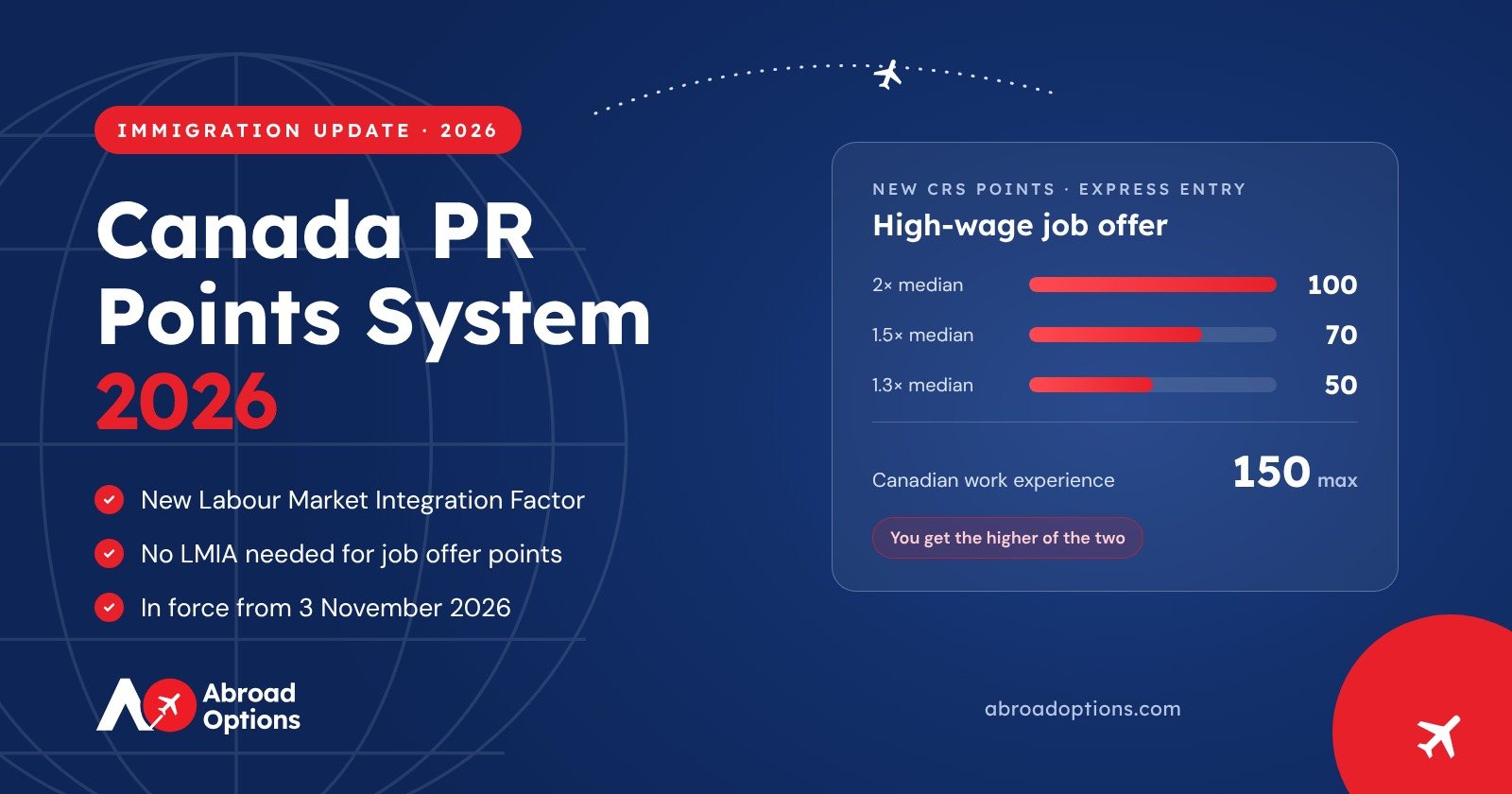
Quick answer: From 3 November 2026, Canada added a new Labour Market Integration Factor to the Comprehensive Ranking System (CRS), the score that decides who gets invited for PR through Express Entry. Candidates can now earn up to 100 points for a job offer in an eligible high-wage occupation (no LMIA needed) or up to 150 points for Canadian work experience in such an occupation. You get whichever is higher, not both. A job offer outside a high-wage occupation earns 0 points, and an LMIA on its own no longer adds any points.
In short, Canada is rewarding people who are already earning well in Canada, or who have a well-paid Canadian job waiting for them. For applicants applying from India with no Canadian job or experience, the core CRS factors (age, education, IELTS/CELPIP or TEF scores, foreign experience) still decide your score.
The changes at a glance
|
What changed |
Before 3 Nov 2026 |
From 3 Nov 2026 |
|---|---|---|
|
Job offer points |
0 (removed in March 2025) |
100 / 70 / 50, based on the occupation's wage level |
|
LMIA needed for job offer points? |
Not applicable |
No — LMIA no longer required or rewarded |
|
Points for high-wage Canadian experience |
None extra |
+70 / +40 / +20 on top of points for years of experience |
|
Maximum for the new factor |
— |
150 points (140 with an accompanying spouse) |
|
Job offer and experience points together? |
— |
No — you get the higher of the two |
|
Job offer in a non-high-wage job |
— |
0 CRS points (can still count for FSW/FST eligibility) |
|
Existing profiles |
— |
Rescored automatically by IRCC |
What exactly changed in the CRS on 3 November 2026?
Immigration, Refugees and Citizenship Canada (IRCC) announced the changes on 16 October 2026 as part of "refocusing Express Entry on top talent that drives economic growth." There are four main changes.
1. A new Labour Market Integration Factor
This is a new block of CRS points with a ceiling of 150 points (or 140 if your spouse or partner is coming with you). You can earn it in one of two ways, and IRCC gives you whichever route scores higher:
- Route A: a qualifying job offer in a high-wage occupation (up to 100 points)
- Route B: Canadian work experience, with a bonus if it is in a high-wage occupation (up to 150 points)
2. Job offer points are back, but only for high-wage jobs
Job offer points were removed in March 2025. They have now returned in a new form. Only offers in an eligible high-wage occupation earn points. A high-wage occupation is one whose median wage is at least 1.3 times Canada's national median wage. IRCC publishes the list, built from three years of Job Bank, Labour Force Survey and Census data.
The offer must generally be full-time, continuous, and for at least one year after you become a permanent resident. An IRCC officer checks that it is genuine: that the employer is actually running a business, that the job makes sense for that business, and that the employer follows employment and recruitment laws.
3. No LMIA needed
A Labour Market Impact Assessment (LMIA) is no longer required for job offer points. Having one also no longer adds points or priority. A temporary public policy also removes the LMIA requirement for job offers used to qualify under the Federal Skilled Worker (FSW) and Federal Skilled Trades (FST) programs, for candidates invited on or after 3 November 2026. For FSW/FST eligibility, the job does not need to be high-wage; any eligible TEER 0–3 job that meets the program rules can count.
4. Extra points for well-paid Canadian experience
If you have at least 12 months of Canadian work experience in high-wage occupations (TEER 0, 1, 2 or 3, within the last 10 years), you get a bonus of 70, 40 or 20 points on top of the points you already get for how many years you worked in Canada.
Also new from 17 November 2026: university professors and lecturers (NOC 41200) paid through stipends, grants or scholarships can count that work as Canadian experience or a job offer. Post-secondary teaching and research assistants (NOC 41201) are no longer eligible for the "Researchers with Canadian work experience" draw category.
How many CRS points can you get under the new system?
Points for a job offer in a high-wage occupation
|
Occupation's median wage vs national median |
CRS points |
|---|---|
|
2× or above |
100 |
|
1.5× or above |
70 |
|
1.3× or above |
50 |
|
Below 1.3× (not a high-wage occupation) |
0 |
Points for Canadian work experience
You get points for the number of years you have worked in Canada, plus a bonus if at least 12 months of it was in high-wage occupations.
|
Years of Canadian experience |
Duration points |
|---|---|
|
1 year |
40 |
|
2 years |
53 |
|
3 years |
64 |
|
4 years |
72 |
|
5 years or more |
80 |
|
High-wage experience (at least 12 months) |
Bonus points |
|---|---|
|
In occupations at 2× median or above |
+70 |
|
At 1.5× median or above |
+40 |
|
At 1.3× median or above |
+20 |
Example: Priya, a software developer from Hyderabad, has worked in Toronto for 3 years in an occupation paid at 1.5× the national median. She gets 64 + 40 = 104 points from experience. She also has a job offer in the same occupation, worth 70 points. IRCC uses the higher number, so she gets 104, not 174.
The maximum for the whole factor is 150 points (140 with an accompanying spouse). These points are added on top of your core CRS score from age, education, language and foreign experience. A provincial nomination still adds 600 points.
What have recent Express Entry cut-offs looked like?
|
Draw |
Date |
Category |
Invitations |
CRS cut-off |
|---|---|---|---|---|
|
#453 |
28 Oct 2026 |
Transport occupations |
150 |
477 |
|
#452 |
27 Oct 2026 |
French-language proficiency |
5,000 |
407 |
|
#451 |
26 Oct 2026 |
Provincial Nominee Program |
792 |
761 |
|
#450 |
16 Oct 2026 |
French-language proficiency |
5,000 |
435 |
|
#449 |
15 Oct 2026 |
Canadian Experience Class |
2,500 |
519 |
|
#447 |
1 Oct 2026 |
Trade occupations |
3,500 |
476 |
Are draws happening right now? IRCC paused invitation rounds from 3 November 2026 while it rescored every profile in the pool, saying this could take up to two weeks. As of 17 November 2026, no draw had been held under the new rules, and IRCC had not announced a restart date. Because many candidates in Canada have just gained 50–150 points, we expect cut-offs in Canadian Experience Class draws to rise once rounds restart. Check IRCC's rounds-of-invitations page for the latest draw.
What should Indian applicants do now?
If you are applying from India with no Canadian job or experience, the new factor doesn't give you points directly. But the competition has changed. Candidates already in Canada can now jump 50–150 points, so general draw cut-offs may rise. Your best moves:
- Push your language score. Moving from CLB 7 to CLB 9 in IELTS or CELPIP is still the single biggest lift for most Indian profiles. French (TEF/TCF) opens separate French-language draws with much lower cut-offs (407 on 27 October 2026).
- Look at category-based draws. Healthcare, trades, transport and STEM categories often invite candidates with lower scores than general rounds.
- Target a Provincial Nominee Program. A nomination adds 600 points and almost guarantees an invitation.
- Consider a genuine high-wage job offer. Since no LMIA is needed, a Canadian employer can now support you more easily. Be careful: IRCC checks that offers are genuine, and paying for a job offer is illegal and can get you banned.
If you are already in Canada on a work permit or PGWP:
- Log in and check your recalculated score. IRCC is rescoring profiles automatically.
- Confirm your NOC code and wages match an occupation on IRCC's high-wage list.
- Add any qualifying job offer. Until IRCC updates the online form, you may need to select that you have a positive LMIA even if you don't; follow the instructions on IRCC's Express Entry changes page.
- Keep your documents ready: pay slips, T4s, reference letters with duties and hours, and your job offer letter.
If you are a student planning to study in Canada, pick a program that leads to a high-wage occupation. Your Canadian experience after graduation is now worth far more if it is in a well-paid field.
Frequently asked questions
When did the new Canada PR points system start?
The new CRS points took effect on 3 November 2026. IRCC announced them on 16 October 2026.
How many points is a job offer worth for Canada PR now?
A qualifying job offer in a high-wage occupation is worth 100, 70 or 50 points, depending on whether the occupation's median wage is at least 2×, 1.5× or 1.3× Canada's national median. Job offers in other occupations earn 0 CRS points.
Do I still need an LMIA for Express Entry job offer points?
No. From 3 November 2026, an LMIA is not required for job offer points, and having an LMIA no longer adds points. For FSW and FST eligibility, a temporary public policy also removes the LMIA requirement for candidates invited on or after that date.
Can I get points for both a job offer and Canadian experience?
No. IRCC calculates both and gives you the higher score. The new factor is capped at 150 points (140 with an accompanying spouse).
What is a high-wage occupation in Canada?
An occupation whose median wage is at least 1.3 times Canada's national median wage. IRCC publishes the list, based on three years of Job Bank, Labour Force Survey and Census data.
Do I have to update my Express Entry profile?
IRCC rescores existing profiles automatically. If you have a qualifying job offer, add it to your profile. Until the online system is updated, follow IRCC's instructions on how to enter it.
Is the new system bad for applicants in India?
Not directly. Your core points are unchanged. But candidates in Canada can now gain many more points, so you should focus on language scores, French, category-based draws and provincial nominations to stay competitive.
When is the next Express Entry draw?
Draws were paused from 3 November 2026 while IRCC rescored the pool, which it said could take up to two weeks. As of 17 November 2026, IRCC had not announced a restart date.
Get your CRS score checked under the new rules
Not sure where you stand after the 3 November changes? Abroad Options in Hyderabad will check your profile against the new CRS rules, tell you your realistic score, and map the fastest route for you: language improvement, a provincial nominee program, or a category-based draw.
Book a free Canada PR assessment or call +91 8333041888. You can also read more on our Canada PR Visa page.
Disclaimer: This article is general information based on IRCC announcements up to 18 November 2026. Immigration rules change often. Always check the official IRCC website or speak to a licensed adviser before you apply.
Sources
- Canada refocusing Express Entry on top talent that drives economic growth — IRCC news release, 16 October 2026
- Changes to Express Entry for high-wage occupations — IRCC backgrounder, October 2026
- 2026 changes to the Express Entry system — IRCC, updated 18 November 2026
- Express Entry reforms 2026 — CIC News, October 2026
- Express Entry changes effective November 3, 2026 — Newland Chase
- Express Entry draws history — Aval Visa, updated 17 November 2026
Need advice on your own case?
Get a free, honest assessment from our counsellors.